
CCNA Content Changes and Your Reaction: Keep Studying!
Wow. Nine named CCNA certifications, plus CCDA – all being replaced by one CCNA certification come February 2020. Basically, Cisco morphed CCNA Routing and Switching (R&S) into the new CCNA.
So, what should you do, if you were headed towards CCNA R&S? This post takes a brief look at some of the major decision points as related to the content in the exams.
Quick Context
Were you pursuing CCNA R&S (or CCENT) when Cisco announced their sweeping redesign of Cisco career certifications on June 10, 2019? Then this post is for you. This post hits the big ideas, without too much detail, focusing on technology content in the old and new exams.
I will revisit all of these topics over the coming months!
Also, on announce day or the next, I’ll also post this post: Same gist but focused on program changes rather than exam content.
CCNA Program Changes and Your Reaction: Keep Studying!
Overview: What Topics Go Away
As with any transition from an old to a new exam, some topics leave, some topics arrive, some topics stick around as is, some topics stick around but with different depth and emphasis. I’ll explore these ideas here in the blog in some detail over the coming months – I’ve been heads-down writing about it all, so it’s fresh in my mind – but for announcement week, let me get the big ideas out for considerations.
Comparing the existing/old CCNA R&S 200-125 exam topics to the new CCNA 200-301 exam topics, the following are no longer mentioned:
- OSI
- VTP
- RIP
- EIGRP
- eBGP
- IOS licensing
- IOS upgrades
- Most WAN topics (serial, PPP, MPLS, Metro Ethernet)
- APIC-EM
Additionally, a fair number of topics that were listed with the verbs “configure and verify” are now listed with the verb “describe” or similar. Also, the word troubleshoot does not appear in the CCNA 200-301 blueprint.
Overview: What New Topics Appear
The new CCNA 200-301 exam blueprint includes some new topics. I’ve listed the number of chapters in my new books that cover each, for perspective. The larger new topics include:
- Wireless LANs (perspective: 4 chapters in my new books)
- Dynamic ARP Inspection and DHCP Snooping (1 Chapter)
- Security Architectures (1 Chapter)
- Overlay, Underlay, Fabric, DNA Center (1 chapter)
- Ansible, Puppet, Chef (1 chapter)
- JSON, structured data, REST (1 chapter)
That might seem like a lot of new content, but comparing past changes to the CCNA R&S exam, it’s not a lot of new content. For perspective, my existing CCNA Cert Guides have 64 chapters combined (short chapters to make it easy to get through one chapter in one study session.) The new books will have 48 Chapters (25% reduction in comparison). Of those, nine of the 48 cover the larger all-new content, with other smaller new topics spread around in the context of other chapters.
Changes in Content
Once we get closer to Feb 2020, I plan to create a blog post that tells you how to better study for the new CCNA if you use existing study materials. That said, there are two notable subtle changes to topics that remain but the focus changes:
Troubleshooting: The root word “troubleshoot” does not exist in the blueprint for the new exam. The current CCNA 200-125 blueprint uses that verb 28 times in the 66 exam topics that have verbs: yes, about 40% of the existing CCNA R&S exam topics used the verb “troubleshoot”. 0% for the new 200-301 exam blueprint. It will be interesting to see the effect of this change in the actual exam.
Describe vs. Config/Verify: A number of technologies have exam topics with verbs “configure and verify” in the old CCNA 200-125 blueprint, with the new blueprint listing the same technology but with a verb like “describe” or “compare and contrast”. Just to list a few off the top of my head: HSRP, SNMP, RSTP+.
Net: New CCNA is Smaller
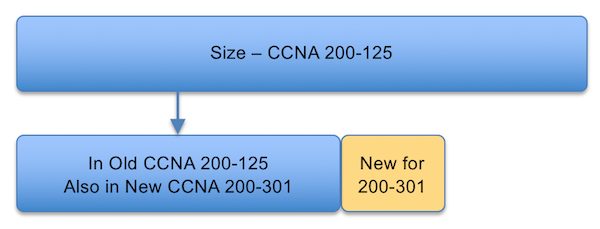
By my estimation, the new CCNA 200-301 – with the exam availability in February 2020 – is about 25% smaller than the current CCNA 200-125 exam. That should be roughly true of the book page count when the dust settles, along with other measurements.
Your Decision Hinges on Your Motivations
You have decisions to make. Let me get us started on that conversation with a couple of examples, and we can chat about questions and variations here. I’m sure I’ll revisit this topic a few times during our 8.5-month transition.
First, ask yourself: Why are you pursuing a certification in the first place? Is it the certification? Is it the next certification, or the next? Is it some of the things you get by being certified – like a job interview, or landing a job? Is it more the skills and knowledge, or the things you get from having that skill/knowledge?
Your motivations will drive your path as to whether you keep going and pass the Cisco exams available through February 2020, or if you change course and plan to pass the new exams. Here are a few examples for people currently pursuing CCNA R&S to get us thinking and talking.
Motivation: Get CCNP R&S Certified? Keep Learning CCNA
If your primary interest in CCNA R&S was because it was a prerequisite for CCNP R&S, then don’t wait 8 months for the new certs! Keep learning.
Note that CCNP Routing and Switching (R&S) morphs into CCNP Enterprise with the program changes, or at least that’s the closest comparison.
To understand why I land on “keep learning”, you need to know some differences with what happened to CCNP. The closest new CCNP to the old CCNP R&S is the new CCNP Enterprise. All the new CCNP certifications require you to take one Core exam, plus one of several Concentration exams. If you look at the exams for CCNP Enterprise, the CCNP Enterprise Core, plus the CCNP Enterprise Advanced Routing exam, come the closest to matching the old CCNP R&S – just with less content to learn.
The reason I say “keep learning CCNA” is this: Your study for the current CCNA R&S prepares you for several topics in the CCNP Enterprise exams. Some support for that:
- The new CCNA is smaller than the old CCNA R&S, and some of that moved to CCNP Enterprise. But for future CCNP Enterprise folks, the old CCNA covers topics you will need for CCNP – and you can study for those now.
- I see about 11 chapters from my CCNA Cert Guides that apply directly to content in the CCNP Core, EG, some OSPF, STP/RSTP configuration and troubleshooting.
- EIGRP does not make an appearance until the CCNP Enterprise Advanced Routing exam (you would go ahead and learn about EIGRP for the existing CCNA 200-125 exam).
Motivation: Certification (CCNA) Focused? 50/50
Now let’s consider the case in which you were pursuing CCNA R&S certification, you weren’t planning to do more with Cisco certs, and you did not care as much about the content as you did about the certification. Maybe you just wanted to round out your resume’, maybe you want certifications from several different technology areas, and so on. But your goal is the certification, and the skills are a bonus.
I would say this is a rare case in which you might consider waiting to take the new exam. (You can keep studying, but for the topics in the new exam.) I say that you might want to wait because there are other reasons to keep studying to pass the existing CCNA R&S exams. But here are some reasons to wait:
- The new CCNA (based on exam 200-301) is smaller in the sheer volume of topics to learn.
- The new CCNA adds some more modern and currently-useful technologies for today while removing two topics (RIP and VTP) that you will probably never use.
If you choose this path, consider a study plan that lets you wrap your study not long after the new exams come out in February 2020.
However, for you, I’d also consider passing the existing CCNA R&S 200-125 exam. Reasons:
- You’re already half of the way finished studying for the existing CCNA, so it’s better to finish rather than to forget what you learned over these next 8.5 months.
- Who knows, maybe you’ll decide to go for a CCNP Enterprise certification, so you may as well keep rolling.
Motivation: Skills (CCNA) Focused? Keep Studying
If your motivation to pursue CCNA R&S is more about getting the skills, with the certification being a nice side effect, then your path should be clear: keep studying. Here are some reasons why:
- 8 months is a long time to wait for the new exams, so don’t lose your momentum – keep studying.
- Of the topics you would have to learn for CCNA R&S but that you would not have to learn for the new CCNA, all are useful except a couple: RIP, and probably VTP. The rest are still useful things to know.
- You can wrap your learning with the tools you already own, rather than buying new CCNA study products, so no need to spend more cash to buy new study tools for the new exams.
How about You?
I imagine this post will spark some thought and discussion. Fire away with your opinions, thoughts, questions, and so on. Note that I’m posting this while I’m at Cisco Live 2019, and it’s a busy week, but I’ll make sure and follow up as soon as I can to your comments – even if I don’t get to them until I’m on the plane coming home from the show.